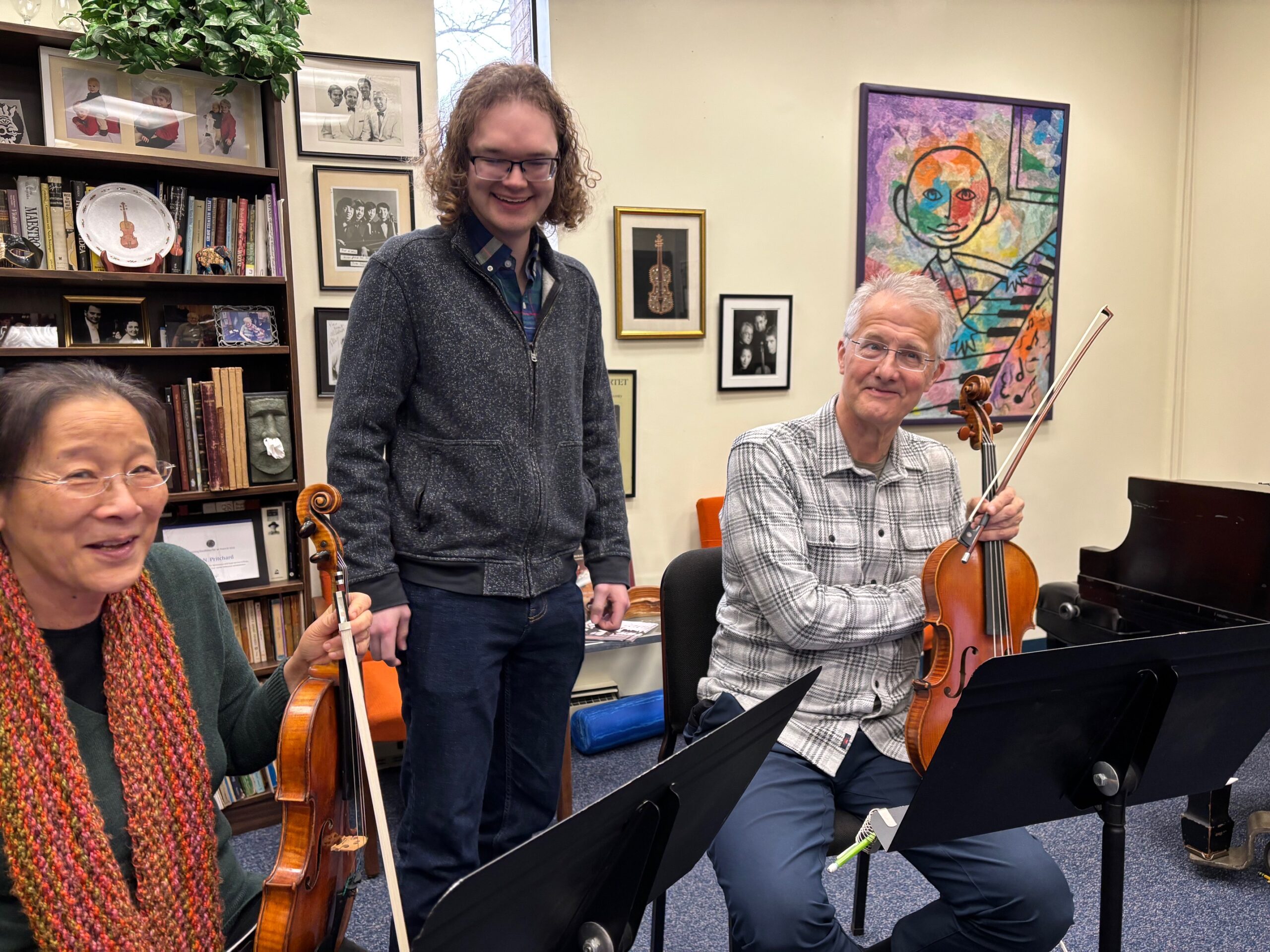
by Jacob Smith
Commissioned in 2026 as part of the Portfolio Project.
Program Note
“Move fast and break things. Unless you are breaking stuff, you are not moving fast enough.”
– Mark Zuckerberg
This quote, attributed to Meta CEO Mark Zuckerberg regarding his company’s approach to innovation, has received both widespread acclaim and criticism since its publishing. Some see it as the key to how the company has achieved the success it has. Others see it as encapsulating everything wrong with the world of modern technology. But, fundamentally, this quote is about the capitalistic free market more so than just the tech sphere. It acts as both a rallying cry and a stark warning regarding the blind rush into innovation for financial gain. And this blind rush can cause major issues—just not for the folks at the head of the operation, who are frequently isolated from the consequences of their actions through layers of financial and legal maneuvering. Most of the time, these fall onto other parties—society, politics, the end user, social discourse, the environment, and others who may not have any relation at all.
Move Fast, Break Things encapsulates this by treating melody as commodity—something to be bought, used, sold, and trashed. Musical elements pop in and out of the intense, noisy texture, crowded with the calls of newer, bigger, and better things. Sometimes all of the parts are on the same page, heading toward the same goal in slightly different ways. Sometimes they begin on the same page, but diverge as the need to stand out and diversify grows. And sometimes they’re just scattered, overlapping and stepping on one another trying to find a stable footing in an inherently unstable musical landscape. Rhythms and harmonies get broken. Textures fall apart. Melodies are split amongst parts, sometimes attempting to compete with and outpace each other, even if they’re playing the same fundamental thing. With that being said, there is still an overall sense of synchronicity between each part, giving the piece a sense of necessary cohesion—even if one part falls behind, it catches up, or goes off into something else entirely. Sometimes elements reappear and patterns emerge, maybe a little different than previously. And, of course, the piece moves fast.
Entire formal sections are seemingly gone in the blink of an eye just as soon as they appear, almost like they were meant to be larger, but never got the chance to grow. And others drone on for longer, occasionally stagnating before a major shakeup, and the cycle begins again. Be it for financial, societal, or even musical advantage, Move Fast, Break Things symbolizes the constant rat race towards a capitalistic, reactionary “future,” and the nature of “progress” in a fast-moving, overwhelming world.
Composer Biography
Composer and pianist Jacob Alan Smith (b. 2002), born in the Appalachian Mountains of North Carolina, explores the expressive potential of musicians and ensembles through loop-based variation and gradual twisting of melodies through reharmonization and rhythmic mutation. An experimenter in both acoustic and digital sound, his music frequently blends mediums and incorporates improvisation and performer interpretation. He has collaborated with other artists and composers on projects ranging from prepared piano to collaborative electronic structured improvisation.
As a member of the innovative new duo Ivory Out of Time, alongside fellow composer William Rhodes, he has written and performed new works for chamber ensembles, inspired by the unique spirit of progressive rock/jazz and infused with a signature sense of humor that sets them apart. His compositional inspirations are smashed together from a variety of styles, including blues, contemporary jazz, prog rock, funk, EDM, VGM, ragtime, Appalachian folk, and his background as a classically-trained pianist. He has presented and had work premiered on an international scale, including (but not limited to) the U.S., the U.K., China, South Korea, Australia, and several countries in Europe and South America. His works are typically identified by their rich harmonies, rhythmic variety, and central focus on a set of melodic motifs.